Tuesday, September 25, 2012

CREATIVE TIME: Annice Jacoby

On October 12, the Arts Research Center at UC Berkeley and the Curatorial Practice at the California College of the Arts are partnering to host a live-streaming of the Creative Time Summit, an annual conference in New York that brings together cultural producers--including artists, critics, writers, and curators--to discuss how their work engages pressing issues affecting our world. To jump-start the conversation in advance of the event, attendees have been asked to submit a paragraph on a keyword associated with one of the summit themes: Inequities, Occupations, Making, or Tactics. This posting is by Annice Jacoby, author and artist.

Keyword: MAKING

Sweet etymology reveals that the root of Poet is a Maker. In the historical sweep of what we say and do, this linguistic link from the practical to the lyrical, embraces our survival, management, creativity, resourcefulness, connections, communications and all that jazz broadly labeled “culture”.  Art, as everyday ecstasy, ingenuity, occupation and pre-occupation, is a basic activity that, like language, belongs to all, but alas exercised in a inexhaustible variety of ways, delicious to disruptive, dismal to dynamic. What we make, as Artists, with a capital A, are conscious gifts, conceived and crafted with the integrity of a good cook. Making something from nothing, transforming ingredients, understanding process, tradition, changing conditions, inventing and share what we make to nourish and serve. Sometimes we make a mess. Sometimes a marvel. Whatever we make, Art serves as Agency for our collective experience, capacity and imagination. 

Tuesday, September 18, 2012

LOCATION/TRANSLATION: Joseph del Pesco

The Arts Research Center at UC Berkeley will present the symposium Location/Translation: Art and Engagement from the Local to the Global on September 19, 2012. To jump-start the conversation in advance of the event, the speakers have been invited to respond to the questions "What does 'local' mean to you? How does it get utilized in your work, if at all?" This posting is by Joseph del Pesco,  Director of the Kadist Art Foundation in San Francisco.

I'd like to share this short text written by artist Ben Kimont:

Passing On

“From musical compositions to recipes to instruction pieces, people have been sharing their making, meaning, and authorship with others. When a pianist follows a score, a chef cooks a dish, or a person follows an instruction piece, variations and interpretations are made and shared. In this way a sound, a taste, or an idea is passed on, appreciated, and yet also changed by this new maker, perhaps with new instruments and ingredients and within a new context. Whether the others involved are an audience, those around the table, or visitors to a museum, this experience takes on a broader meaning due to its place in a progression, an atemporal community of makers connected through their consideration of a given idea. But by acknowledging these other composers, chefs, and artists who have worked with the idea before, we can see authorship as residing in a multitude of makers and participants, and perhaps from this loosening of the idea of the single author, we can better get to the content of the work at hand. Perhaps this will make it is easier to say, sit back and enjoy the show, enjoy the meal, enjoy the idea we are passing on.”

BK 2011

Tuesday, September 4, 2012

LOCATION/TRANSLATION: Apsara DiQuinzio

The Arts Research Center at UC Berkeley will present the symposium Location/Translation: Art and Engagement from the Local to the Global on September 19, 2012. To jump-start the conversation in advance of the event, the speakers have been invited to respond to the questions "What does 'local' mean to you? How does it get utilized in your work, if at all?" This posting is by Apsara DiQuinzio,  Assistant Curator of Painting and Sculpture at SFMOMA.


Apsara DiQuinzio

When I first moved to San Francisco, over six years ago, for a job at the San Francisco Museum of Modern Art, the recurring refrain I often heard from people living here and working in the field of contemporary art was that the region’s art scene tended to be rather “provincial.” I found this pejorative qualifier highly problematic, and in many ways it remains a perception artists living in the Bay Area struggle to overcome.  For example, an artist I know recently appeared in a major national exhibition, and on his wall label in the exhibition he had been described as a “San Francisco-based artist.” Upon seeing this descriptor, he insisted that they remove it from the label. This artist didn’t want to be defined by his location; he wanted to just be a (good) artist. But his desire to shed his San Francisco roots in print, mostly likely had something to do with this problematic perception of “the provincial.”

But what makes San Francisco more or less “provincial” than New York?  Having moved to San Francisco from New York, where I had lived for over five years, I often found that the New York art scene could be just as provincial (if not more!) as any other region, it’s just that its scale masks it. But in reality, no place is immune from provincialism; it is everywhere and anywhere. Solipsism and narrow-mindedness undergird the problem of the provincial. In this day and age, when a place is provincial, the local is all that matters, and there is a reluctance, or inability, to look beyond. You become too comfortable or satisfied in the local that you forget that there is a larger world out there that also informs your own domain.

Yet, the local and the international are not separate spheres; they are connected and contingent upon one another. We are all local and international simultaneously. An insistence on their separation is dangerous, and when unchecked gives rise to problematic notions of isolationism and nationalism. This is largely what happened in Romania, which Mihnea Mircan discusses below, where nationalism grew to obscene levels under a brutal totalitarian regime. Its grandiosity became untenable for a people who were starving and dying as their dictator used all the country’s money, not to feed and protect them, but to build a monstrous monument to himself that now stands in a ruinous half-life.

I think some of the most vital encounters in art and life arise from a tracing of these points of contact—where the local and the international converge.  Kwame Anthony Appiah has written eloquently about this in his book Cosmopolitanism: Ethics in a World of Strangers, where he makes the case for “contamination.” In our 21st century world, purity no longer exists; everything is hybrid, networked, co-inhabited, and shared. I tried to explore some of our interconnected terrains in an exhibition called Six Lines of Flight: Shifting Geographies in Contemporary Art, which opens at SFMOMA on September 15th. It features inspirational artists from six cities around the world who, often working against a backdrop of war, have created both local and international platforms for artistic activity, collective engagement, and critical awareness.

Thursday, August 30, 2012

LOCATION/TRANSLATION: Sanjit Sethi

The Arts Research Center at UC Berkeley will present the symposium Location/Translation: Art and Engagement from the Local to the Global on September 19, 2012. To jump-start the conversation in advance of the event, the speakers have been invited to respond to the questions "What does 'local' mean to you? How does it get utilized in your work, if at all?" This posting is by Sanjit Sethi,  Director of the Center for Art and Public Life and Chair of the Community Arts Program at the California College of the Arts.

Sanjit Sethi

A few years ago the Center for Art and Public Life facilitated a collaboration between a ceramics course and the design group Rebar to create nesting modules for a species of concern on an island off the coast of Santa Cruz, California. The project was very specific in nature. The birds: Rhinoceros Auklet. The concern: nests being crushed by large elephant seals and sea lions. The material of choice: the pliant and durable medium of ceramics. The location: Ana Neuvo Island. This project emphasizes the local - a specific animal, a specific geography, a specific threat, a specific medium, and a specific solution. And yet through its specificity it had universal implications. It demonstrated that craft mediums have an important role to play in socially responsive projects, and provided a model for solutions around habitat restoration and strategies to address problems for other species of concern. The local had the potential to reach a wider, even global, audience.

What interests me most about working with diverse communities and individuals, such as those involved in the Ana Neuvo Island project, are the questions that arise at the start of these endeavors. These collaborations and interactions often require a great deal of research to discover unseen, hidden, or overlooked components of a story, an issue, or a history. Through this forensic methodology and the subsequent exchanges of information and values the project starts to achieve depth and relevance. Establishing what matters, why it matters, and how it matters is essential to the success of the collaboration and the end product. One of the many things that matters is the local in as much as we need to ask ourselves “why here and not there?” and “how can we ascribe a geography around a project that is based in a specific locality and region?” But, the local is meaningless without considering other things that matter. History matters. Community matters. Socio-economic identity matters. Ethnicity matters. Language matters. Context matters.

Four years ago I completed a olfactory-based memorial in Memphis, Tennessee, the Kuni Wada Bakery Remembrance. This project was the result of research I had done involving the shutting down of a local bakery following the start of World War II. The burst of xenophobic rage that caused a specific community to take specific action on a specific bakery at a specific location had unintended consequences well beyond its specificity. In creating this memorial I interviewed numerous elderly members of the Memphis community who remembered the bakery and spoke of it longingly. Through those conversations it became apparent that in particular these individuals missed the donuts and cinnamon buns that the bakery made. It wasn’t enough for me to create a memorial that pumped out the smell of a generic bakery, but rather I needed to come as close as possible to honoring the specific smells associated with this bakery. In this project it was impossible for me to separate the idea of the local from memory, from history, from nationalism. In the end, the concept of the local offers only one set of variables, which without other factors (community, language, etc.) would be akin to trying to establish location by only providing longitude without latitude.

LOCATION/TRANSLATION: Mihnea Mircan

The Arts Research Center at UC Berkeley will present the symposium Location/Translation: Art and Engagement from the Local to the Global on September 19, 2012. To jump-start the conversation in advance of the event, the speakers have been invited to respond to the questions "What does 'local' mean to you? How does it get utilized in your work, if at all?" This posting is by Mihnea Mircan, Artistic Director of Extra City Kunsthal, Antwerp.

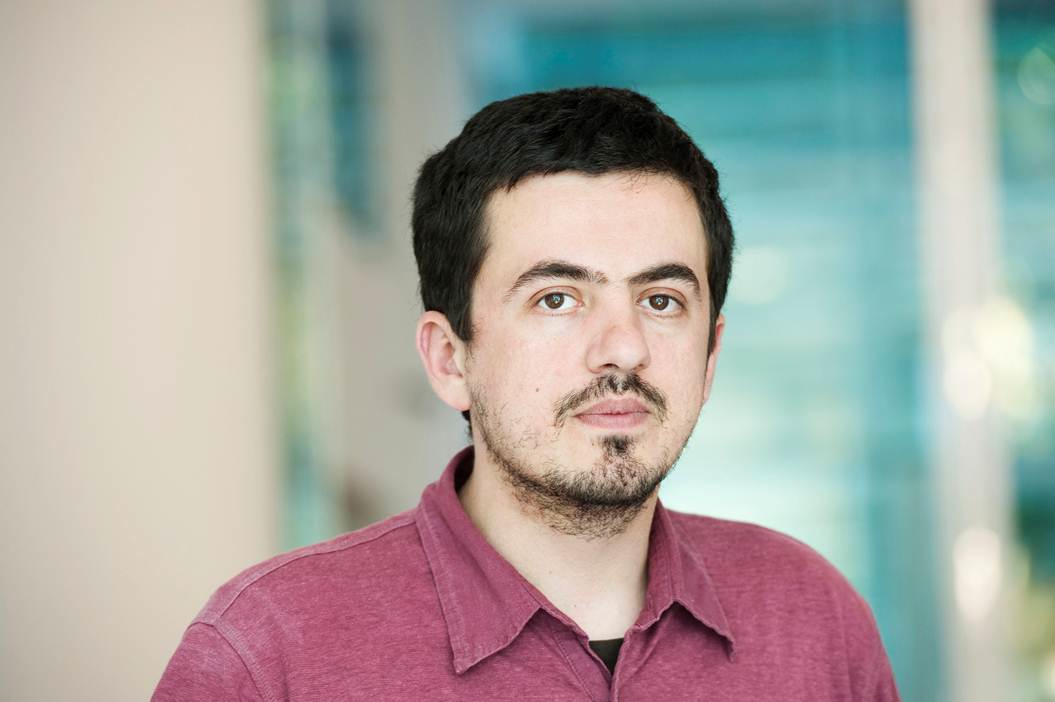
Mihnea Mircan; photo by Raimar Lutz

In 2004, a small wing of the House of the People in Bucharest was rudimentarily converted into a National Museum of Contemporary Art, and I began work as a curator under circumstances that were an apotheosis of the local. Built during the ‘80s, the edifice was to converge the archaic strata of the collective psyche and the political destiny of the Romanian nation, in other words to bring a propagandistically deformed past into an unlikely future of anonymous collectivism and amputated souls. The House of the People was (is? – unless another, dictatorial or neo-liberal or mixed folly has demoted it) the second largest building in the world, erected with costs so colossal that it was less a political metaphor for a depleted future, but rather its oversized metonym. As it was – and is – perpetually undecided whether it wished to be a citadel to daunt absent adversaries, the product of the ‘constructive genius of the Romanian people’, or an impossibly onerous mausoleum for both. When, after the nebulous and brutal events of 1989, the edifice lost its commissioner and prospective occupant, a symbolic rebranding was effected, instead of the work of mending, interrogative suspension and expiation that could have been expected. Renamed Palace of the Parliament, the House was recuperated from that uncomfortable terrain where built megalomania defies understanding, and simply exists with a kind of geological indifference, and transformed into the bastion of Romania’s democratic powers, entitled to it by the very democratic transubstantiation that had them elected. A formidably large and ugly building became the site where the national variant of post-communism would be rehearsed, where Romanian post-communism’s anti-communism could evince all the symptoms of its ambivalence. My understanding of the museum located there as a window to engage, from the center of the margin, what was amiss in the country’s transition to democracy and to polemicize, from within, with an architectural Gordian knot of confusion, anxiety and primitive political reflexes, merits only irony. The first manifestation of that irony was that each exhibition or intervention made there became awkwardly site-specific, and finally fueled the same spirit, sacrificial and operatic, that continued to govern the building. 

Rather than via programmatic oblivion, I extracted myself from this scenario and its toxic levels of localism via a study of the totalitarian logic of monuments in general, or by mistaking the size and frenzied symbolic gesticulation of the House of the People as a belated manifestation of the sublime. A sublime object, grotesquely defiant, but partially comprehensible as an endgame in a longer story – a local climax in the ideological cooptation of the sublime. A monument, perhaps, embodying the same collective Freudian slips that monuments always materialize, on the scale of a tectonic event. The comparison between local idiosyncrasies and the histories they derive from or contort, and whose atavistic strength they testify to, has been one model for my practice so far. A monster, I learned rather late, is nothing more than a presence for whose description we lack the words, words to be either painfully remembered or speculatively articulated.

As a recent immigrant to Belgium (another place of quirky exoticism, where the fundamentals of both country and the European Union, on whose institution this country has had a decisive impact, are continuously subjected to the bipolar disorders of two nationalisms), I have neither a home (although I crave for one), nor a cosmopolitan perspective (although my profession presupposes one). I suspect I belong to a generation that does not belong – one of existential freelancers –, and that has not yet devised the instruments that would allow it to imagine and carve out a collective destination, to cut between belonging and potential futures. ‘Local’ and ‘international’ figure among the tropes used to make sense of this tempest-tossed condition, but with the same precautions required by speaking of a ‘here’ or a ‘now’. Parts of a set of mutable definitions, these sonar signals of a temporary position sometimes encounter hard surfaces and register. A large part of today’s art elaborates the Zenon paradox of a progressively globalized world and its vertiginously localized places, while a smaller number of artists create life-size versions of this entanglement. Works that reconcile ‘here’ and ‘there’, so that, bound with each other, they indicate a shadowy antonym beyond them: a sudden sense of orientation, slightly outside the GPS grid, where elucidation is always accompanied by anxiety.

Making Time Now Viewable Online


In April 2012, the Arts Research Center presented Making Time: Art Across Gallery, Screen, and Stage, a three-day symposium that featured keynotes by curators Sabine Breitwieser (MOMA) and Jens Hoffmann (CCA Wattis Institute for Contemporary Art) and choreographer Ralph Lemon, and conversations with the artists Daniel Joseph Martinez and Allan de Souza. Many other distinguished artists, curators, and scholars spoke on Performance and the Art World; Screening Time: Film & Video in Cinemas, on Stages, and in Galleries; Dancing in the Museum; and Curators Re-skilling/Critics Re-thinking.  Thanks to generous support for documentation from the Pew Center for Arts & Heritage, all sessions of Making Time are now available to be viewed online.  ARC is pleased to share this valuable resource, which we hope will support continued research and reflection on time-based and hybrid art practices and the infrastructures that support them.

Thursday, June 14, 2012

The Seven Recurring Puzzles of Equity in Place-making

The Arts Research Center recently participated in a convening at YBCA organized by Emerging Arts Professionals / SF Bay Area which, among other goals, allowed participants to connect, share knowledge, and examine opportunities and pitfalls when working with hybrid arts and neighborhood revitalization projects. ARC Director Shannon Jackson and Associate Director Michele Rabkin presented these seven "Recurring Puzzles" of Equity in Place-making that have begun to take form through ARC's work with the Art + NEIGHBORHOOD research team, and in particular through conversations at the ART/CITY symposium:

General ARC Points in Relation to Place-making:
Recurring Puzzle #1) "The Arts" mean many things to different stakeholders, who all have different values for what it will do.  Some think that the Arts are about Beauty, some about Community-building, some about Critique, some about Provocations of the Imagination whose outcome is not fully nameable.  Often people bring these different hopes into the room in conversations about Place-making and find themselves confused when they realize that they have different value systems and goals.

Recurring Puzzle #2) "The Arts" also derive from many different forms, each of which may seem to have a different purchase--or not--on place-making. Some are more discursive (poetry, fiction, non-fiction), visual (sculpture, painting), or bodied-based (dance). Even if most practices involve many elements (site-specific theatre, public art social practice, or dance installation), different artists or artist groups may bring different skill sets and artistic standards for evaluating the strength of a place-making art work.  In addition to understanding their place-making function, artists may also want (and deserve) to be evaluated as artists, as people who are innovating in the forms that they create, in comparison to a history of practice and in relation to other contemporary artistic practitioners who they consider their peers.  I think that these professional and artistic aspirations needs to be valued "even" when artists work in a civic sphere. 

Sub-Themes and Questions in recent ARC projects related to Central Market and the city of Berkeley:
Recurring Puzzle #3) Can a city's planning language on the role of the arts in urban vitalization be joined to an artistic language of social engagement in the arts?  Our experience is that there is a rich and methodologically varied conversation in each of these fields, but that the terms and goals of these fields are often developed in parallel conversations.  The habits of research, planning, and practice do not always engage with each other--and do not always understand each other when they do.  For example, my own personal research as a sole-author has been on socially-engaged art, working from an awareness of the past attempts to join the arts to social programs (and the potential and perils that ensue).  The work of my colleague Karen Chapple, Associate Director of the Institute for Urban & Regional Development at UC Berkeley, came from a different direction, where there is awareness of the long history of many civic initiatives, civic value systems, as well as city planning research methodologies. Is it possible to integrate these trajectories better, to take seriously the artistic significance of these projects without seeming to dilute their significance for urban planning--and vice versa?   And to what degree must this integration come to terms with different understandings of "outcome"?

Recurring Puzzle #4) How can we develop standards and support systems for artist projects where the "material" of the art event is itself a place-making practice?  This is my way of trying to integrate an aesthetic imagination into the city-planning discourse, hoping we could also evaluate the strength, techniques, and effects of different projects in both artistic and social terms. To use a vocabulary from the arts, I myself am interested in projects where "the context" is not outside the text, where what is usually the background is part of the foreground.  In site-specific projects, the city infrastructure becomes "the set" or the "exhibition space;" in social practice and documentary theatre projects, the processes of creating social relationships are part of the process and product of the art event and/or of the "dialogue" of the play.  As more artists begin to identify themselves as "research-based" artists, how can urban planning research be conducted as part of the art process itself? Examples of this conjunction arose in both our Central Market Arts practice as well as from conversations that came forward in our recent Art/City gathering.

Recurring Puzzle #5) Can the Creative Class discourse think more about class difference?  Many art-based place-projects invoke the language of "creativity" and the "creative class."  We know that this language actually does not always think about actual class difference, between "creatives" and existent neighbors as well as within the "creative class" itself--artists, hairdressers, technology entrepreneurs, and restaurant owners are all part of the so-called "creative class" but enjoy very different levels of economic security.

Recurring Puzzle #6) There is a constant tension in the effort to legitimate artists' creativity in urban arts planning.  On the one hand, artists and artistic groups are celebrated for their "out of the box" thinking and valued as key to the economic vitalization of neighborhoods.  On the other hand, artists and artistic groups are also critiqued for not being "fiscally fit," for not having the know-how to be viable economically.  If both of these assumptions can be true at once, how can we reconcile the fact that they seem quite contradictory?  Is each frame missing something that the other is recognizing?

Recurring Puzzle #7) How can we better reward artistic organizations for collaborating in the production of a shared arts ecology?  There are more instances of attempts to do just that in San Francisco, certainly in Oakland, and hopefully more in Berkeley.  However, there can be a concern that often one organization wants to be the "lead" organization in developing the ecology. Often granting agencies reinforce the sense that one organization needs to lead--and will receive the economic capital to serve that function. Additionally, there is a feeling that large art organizations--the larger museums, theaters, or festivals--are using up all the oxygen from a neighborhood or city, leaving little for small and mid-size organizations to thrive.  How can we incentivize larger organizations to mentor, support, or release opportunities to small organizations?  Can we combat the mistrust that some small organizations feel toward larger ones? How can equity in 'place-making' also mean equity amongst arts organizations, creating a reciprocal, nimble, and thriving playing field for all different kinds of art organizations and constituencies?